Updated July 12, 2026
9 Best Shopify Fulfillment and Shipping Apps for 2026
Shopify fulfillment apps cover several different jobs: carrier rates, labels, tracking, returns, inventory, dropshipping, and 3PL handoff. We compared nine options by the Shopify workflow they actually own, current software pricing, and the point where a merchant needs a service or WMS instead of another app.
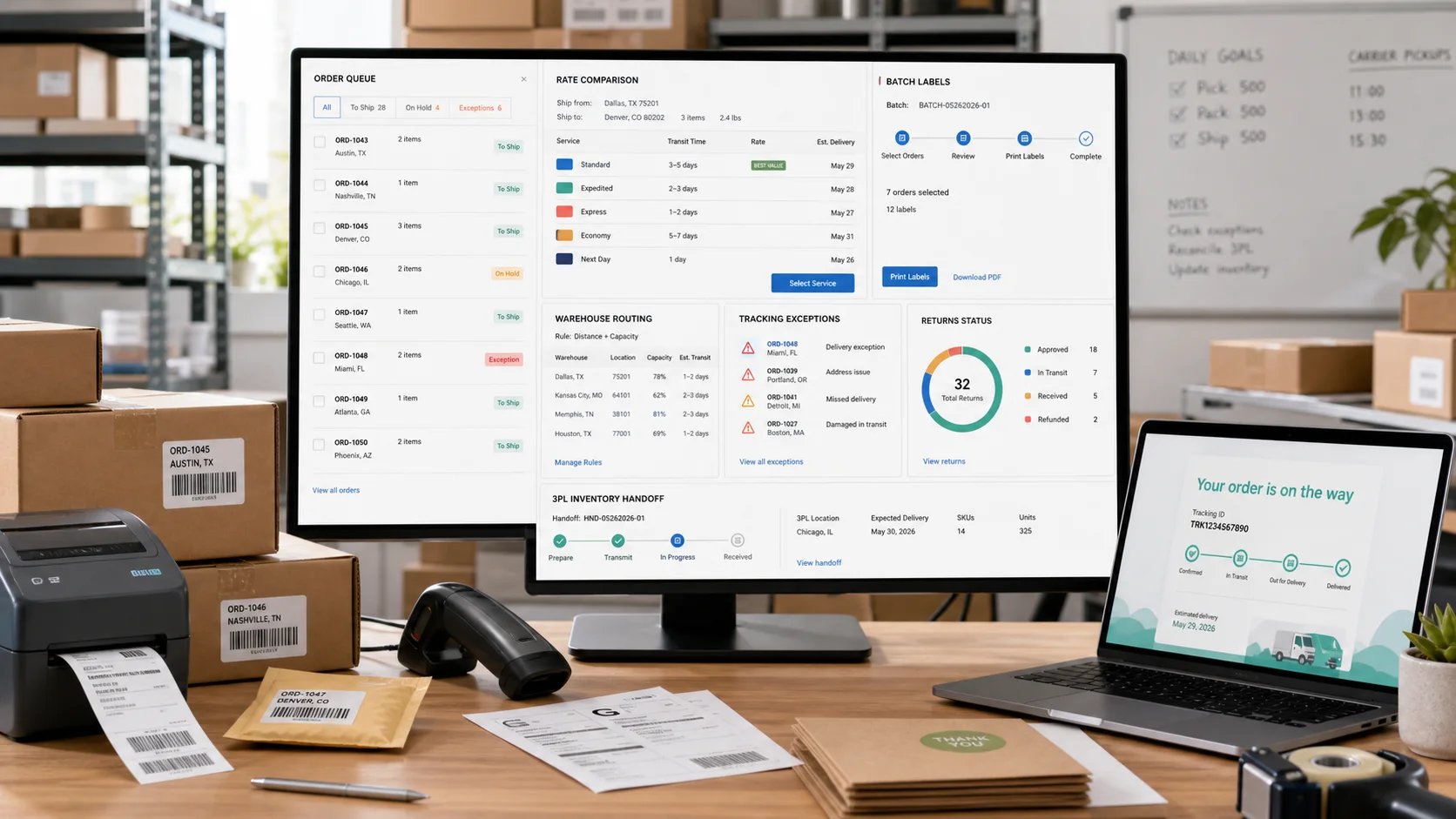
Quick verdict: ShipStation is the best general in-house shipping app. AfterShip owns the post-purchase tracking layer. Pirate Ship is the cleanest free USPS/UPS option. EasyShip fits cross-border operations. ShipBob and Red Stag are 3PL services connected to Shopify, not comparable label subscriptions.
Start with the operational bottleneck
Shopify Fulfillment Apps Compared
The table separates self-serve apps from physical fulfillment services. Postage, carrier adjustments, insurance, packaging, and 3PL operating fees are not included in software subscription prices.
| App or Service | Workflow Type | 2026 Software Price | Shopify Handoff | Best For |
|---|---|---|---|---|
| 1. ShipStation | Multi-carrier shipping and light warehouse operations | Starter from $14.99/mo; Standard from $29.99; Premium from $349.99 | Imports orders and sends shipment and tracking updates back to Shopify | Merchants that pack orders themselves and need rate shopping, batch labels, rules, returns, and multiple selling channels. |
| 2. AfterShip | Tracking, notifications, estimated delivery, and returns | Tracking Essentials from $29/mo; Premium from $59; Enterprise custom | Syncs shipment data and powers branded tracking and notifications after fulfillment | Brands whose main problem is delivery visibility, customer notifications, tracking pages, exceptions, and WISMO support load. |
| 3. Ordoro | Shipping software with optional inventory and dropship apps | Shipping starts free; Inventory from $349/mo; Dropshipping from $299/mo | Connects Shopify and other channels to a shared shipping and operations workspace | Multi-channel merchants that want shipping now and may later add inventory control, purchase orders, or supplier routing. |
| 4. ShipBob | Third-party logistics network with merchant software | Custom quote; software is included for fulfillment customers | Direct two-way order, inventory, shipment, and tracking integration | Scaling brands ready to move inventory, picking, packing, and shipping from an internal team to a distributed 3PL. |
| 5. EasyShip | Global multi-carrier shipping dashboard and API | Free plan; paid Plus, Premier, and Enterprise plans | Syncs Shopify orders for labels, courier selection, duties, taxes, and tracking | Merchants shipping internationally who need courier comparison, duties and tax tools, customs support, and checkout rates. |
| 6. Pirate Ship | Free USPS and UPS label software | No subscription, markup, minimum, or per-label software fee | Imports unfulfilled orders, buys labels, marks orders fulfilled, and returns tracking | US merchants that primarily use USPS and UPS and want a simple, genuinely free label workflow. |
| 7. Shippo | Multi-carrier shipping app with developer API | Starter free up to 30 labels; Pro from $17/mo annually; Premier custom | Connects stores, imports orders, purchases labels, and returns tracking events | Small teams that want a free start and growing teams that need branded tracking, own carrier accounts, or API-driven workflows. |
| 8. Red Stag Fulfillment | Specialized third-party logistics service | Custom quote based on products, volume, storage, handling, and shipping | Native Shopify support plus API and custom integration options | Brands shipping heavy, bulky, high-value, fragile, or operationally specialized products that need hands-on 3PL handling. |
| 9. Shopify Shipping | Built-in order fulfillment and shipping features | No separate app subscription; label and optional service charges still apply | Native inside Shopify admin with no external order synchronization | Stores in eligible regions with straightforward labels, carrier comparison, documents, tracking, insurance, and returns. |
Pricing checked July 12, 2026. Confirm the live plan selector, billing interval, region, shipment band, carrier-account fees, and physical fulfillment quote before purchasing.
Best App by Fulfillment Workflow
| Need | Shortlist | Why |
|---|---|---|
| In-house multi-carrier shipping | ShipStation or Shippo | Both centralize orders, rates, labels, and tracking; ShipStation adds more warehouse depth. |
| Free USPS and UPS labels | Pirate Ship | No software fee or markup, with direct Shopify order import and fulfillment updates. |
| Branded tracking and delivery notifications | AfterShip | The app is purpose-built for the post-purchase journey rather than warehouse execution. |
| International courier, tax, and duty workflows | EasyShip | Cross-border courier comparison and landed-cost tools are the center of the product. |
| Inventory or dropship operations around shipping | Ordoro | Shipping starts free, with separate inventory and dropshipping modules as operations expand. |
| Outsource physical fulfillment | ShipBob or Red Stag | These are 3PL relationships, not comparable monthly label apps. |
| Simple native Shopify workflow | Shopify Shipping | Use built-in labels and fulfillment features before adding overlapping subscriptions. |
Detailed Reviews and Current Pricing
1. ShipStation - Best overall Shopify shipping app for in-house fulfillment
ShipStation is the strongest all-around pick when Shopify is one sales channel inside a larger in-house shipping operation. The current product combines order import, multi-carrier rates, label batches, automation, returns, tracking, inventory, and warehouse features with separate depth across Starter, Standard, and Premium.
Pricing
Starter from $14.99/mo; Standard from $29.99; Premium from $349.99
Volume Model
Starter pricing scales from 50 to 5,000 shipments; higher tiers support larger volumes
Shopify Handoff
Imports orders and sends shipment and tracking updates back to Shopify
- 200+ supported global carriers
- Unlimited store connections on paid plans
- Rate shopping, labels, returns, and tracking
Watch for: Pricing changes with both plan and shipment band. Standard is required for your own carrier accounts, unlimited automation types, branded tracking, API access, and stronger warehouse workflows.
Compare ShipStation for Shopify2. AfterShip - Best post-purchase tracking app
AfterShip is not a label-first warehouse tool. It sits after the fulfillment event and improves the customer-facing journey with carrier detection, delivery status, branded tracking, notifications, estimated delivery, analytics, API access, and exception visibility.
Pricing
Tracking Essentials from $29/mo; Premium from $59; Enterprise custom
Volume Model
Displayed starting plans include 6,000 shipments per year; overages apply
Shopify Handoff
Syncs shipment data and powers branded tracking and notifications after fulfillment
- Branded tracking and milestone notifications
- Carrier detection and shipment status analytics
- Separate Returns module when needed
Watch for: AfterShip sells multiple products separately. Tracking, Returns, Protection, Warranty, and other modules have their own prices and usage limits.
Compare AfterShip tracking3. Ordoro - Best modular shipping, inventory, and dropshipping app
Ordoro now sells distinct Shipping, Inventory, and Dropshipping apps. Shipping can start free, while more complex inventory and supplier-routing workflows carry separate monthly prices. That structure works for teams that want to add operational depth without buying every module on day one.
Pricing
Shipping starts free; Inventory from $349/mo; Dropshipping from $299/mo
Volume Model
Module and bundled pricing depend on the operational scope selected
Shopify Handoff
Connects Shopify and other channels to a shared shipping and operations workspace
- Free starting point for shipping
- Optional inventory and purchase-order workflows
- Optional dropship supplier automation
Watch for: Ordoro is software, not a 3PL. Its current pricing is modular, so the old $59/$199/$399 plan framing no longer reflects the product line.
4. ShipBob - Best Shopify integration for outsourced fulfillment
ShipBob connects Shopify to its fulfillment network and dashboard. Orders and inventory flow into the 3PL, while shipment and tracking information returns to Shopify. Quotes are customized; the technology is included for customers, while physical operations drive the actual cost.
Pricing
Custom quote; software is included for fulfillment customers
Volume Model
Quote includes implementation, receiving, storage, fulfillment, and shipping inputs
Shopify Handoff
Direct two-way order, inventory, shipment, and tracking integration
- Direct Shopify integration
- Distributed fulfillment and inventory visibility
- Custom receiving, storage, pick-pack, and shipping quote
Watch for: ShipBob is a fulfillment service, not a comparable monthly shipping-app subscription. Model receiving, storage, pick-pack, shipping, returns, minimums, and value-added work.
Compare ShipBob fulfillment5. EasyShip - Best cross-border shipping app
Easyship is strongest when international complexity matters more than warehouse management. Its platform compares hundreds of courier services and adds tax, duty, customs, checkout-rate, insurance, and API tools around the Shopify order flow.
Pricing
Free plan; paid Plus, Premier, and Enterprise plans
Volume Model
Plan limits and live prices vary by location and billing selection
Shopify Handoff
Syncs Shopify orders for labels, courier selection, duties, taxes, and tracking
- 550+ courier services advertised
- Tax and duty calculation tools
- Dashboard and API access
Watch for: Confirm the live plan selector for your region. Paid plans add features such as own courier accounts, checkout rates, returns, multibox shipping, and support depth.
6. Pirate Ship - Best free Shopify shipping app
Pirate Ship has a current Shopify App Store integration and remains free. It imports Shopify orders, supports large label batches, marks shipped orders fulfilled, and sends tracking back. The tradeoff is a narrower carrier and operational scope.
Pricing
No subscription, markup, minimum, or per-label software fee
Volume Model
Unlimited batch processing; pay only for postage and optional services
Shopify Handoff
Imports unfulfilled orders, buys labels, marks orders fulfilled, and returns tracking
- No software subscription or label markup
- USPS and UPS discounted rates
- Shopify order import and fulfillment update
Watch for: Pirate Ship does not display its live rates to customers at Shopify checkout. It is also narrower than multi-carrier platforms built for many carriers, WMS workflows, or complex automation.
7. Shippo - Best low-cost multi-carrier app and API path
Shippo gives Shopify merchants a compact app with carrier discounts, store connections, labels, returns, tracking, and reporting. Its free tier is limited to 30 labels per month; Pro adds branding, more users, and own-carrier support without the Starter per-label connection fee.
Pricing
Starter free up to 30 labels; Pro from $17/mo annually; Premier custom
Volume Model
Pro scales through 10,000 labels; Premier supports unlimited labels
Shopify Handoff
Connects stores, imports orders, purchases labels, and returns tracking events
- Free Starter plan for up to 30 labels
- Pro from $17 monthly on annual billing
- App and API routes for shipping workflows
Watch for: Starter charges $0.05 per label when using an attached carrier account. Pro pricing changes by label band, and API calls outside Shippo labels can carry separate usage costs.
8. Red Stag Fulfillment - Best Shopify 3PL integration for heavy or bulky products
Red Stag connects Shopify to its fulfillment operations and specializes in products that are harder to store, handle, and ship. It uses custom pricing and supports native Shopify connectivity as well as deeper API or custom integrations for more complex setups.
Pricing
Custom quote based on products, volume, storage, handling, and shipping
Volume Model
Designed around custom fulfillment requirements rather than app shipment tiers
Shopify Handoff
Native Shopify support plus API and custom integration options
- Native Shopify support
- Custom API and integration options
- Specialized heavy and bulky fulfillment
Watch for: This is a service relationship rather than a self-serve shipping app. Validate warehouse geography, receiving, packaging tests, freight, returns, minimums, and service guarantees in the quote.
9. Shopify Shipping - Best native starting point for simple Shopify shipping
Shopify already includes a substantial shipping baseline: order processing, discounted labels in supported regions, bulk label buying, documents, tracking, pickups, manifests, insurance, and return workflows. Start here before paying for overlapping app features.
Pricing
No separate app subscription; label and optional service charges still apply
Volume Model
Bulk label purchase supports up to 250 labels at a time
Shopify Handoff
Native inside Shopify admin with no external order synchronization
- Built directly into Shopify admin
- Bulk labels, documents, tracking, and returns
- Carrier availability based on eligible location
Watch for: Carrier availability and discounts vary by country, location, and plan. Apps become useful when the store needs broader carrier choice, automation, branded tracking, WMS depth, or outsourced fulfillment.
Apps vs. Fulfillment Software vs. 3PL Services
This page focuses on Shopify-connected apps and direct integrations used by merchants to move orders into a shipping or fulfillment workflow. The neighboring guides have narrower operational jobs:
- Use Shopify fulfillment software when you need WMS, multi-warehouse, inventory, routing, or higher-volume operations beyond an app-first workflow.
- Use Shopify fulfillment services when you are choosing a 3PL to receive, store, pick, pack, and ship physical inventory.
- Use shipping software when carrier rates, labels, and shipment execution matter across commerce platforms, not only Shopify.
When to Add a WMS
A shipping app is usually enough while the operation revolves around importing paid orders, comparing carrier services, printing labels, and returning tracking. A warehouse management system becomes relevant when work depends on bin locations, receiving, directed pick paths, barcode scans, replenishment, cycle counts, labor controls, lot or serial tracking, and multi-warehouse inventory reconciliation.
Do not use monthly order volume as the only trigger. A low-volume store with complex kits or regulated lots can need WMS controls earlier than a high-volume store shipping one simple SKU.
Shopify App Test Before Launch
- Import paid, partially paid, cancelled, test, preorder, local-pickup, and multi-location orders deliberately.
- Confirm the exact order status and fulfillment event that sends work into the app or 3PL.
- Test split orders, partial fulfillment, address edits, shipping-method mapping, and duplicate prevention.
- Compare displayed rate, purchased label, carrier adjustment, insurance, and customer charge on sample packages.
- Verify tracking, partial cancellation, return, exchange, and exception updates return to the correct Shopify fulfillment.
- Document inventory ownership when Shopify, an app, a WMS, and a 3PL all hold available-to-sell quantities.
- Run a rollback test before enabling automatic routing or fulfillment across every order.
Frequently Asked Questions
What is the best fulfillment app for Shopify?
ShipStation is the strongest general in-house shipping pick, AfterShip is best for tracking, Pirate Ship is best for a free USPS and UPS workflow, Easyship fits cross-border shipping, and ShipBob or Red Stag fit merchants outsourcing physical fulfillment.
What is the best shipping software for Shopify?
For most in-house operations, compare ShipStation, Shippo, Pirate Ship, and Shopify Shipping. The right choice depends on carriers, monthly labels, own-carrier accounts, automation, warehouse depth, tracking, and international requirements.
Is a Shopify fulfillment app the same as a fulfillment service?
No. A shipping or fulfillment app manages digital workflows such as orders, labels, routing, and tracking. A fulfillment service or 3PL physically receives, stores, picks, packs, and ships inventory. ShipBob and Red Stag are service relationships connected to Shopify.
Does Shopify already include shipping software?
Yes. In eligible regions Shopify supports built-in label buying, bulk processing, documents, carrier services, tracking, pickups, manifests, insurance, and return workflows. A third-party app is useful when requirements exceed that native baseline.
Which Shopify shipping app is free?
Pirate Ship has no software fee and charges only for postage and optional services. Shippo has a free Starter plan up to 30 labels per month, Ordoro Shipping starts free, and Easyship offers a free plan with usage limits.
When does a Shopify store need a WMS instead of a shipping app?
Consider warehouse management software when the operation needs directed picking, barcode scanning, bin locations, receiving, replenishment, cycle counts, labor controls, multi-warehouse routing, or detailed inventory reconciliation beyond labels and tracking.
Related Shopify Guides
Methodology and Primary Sources
We compared the Shopify handoff, operational job, current public subscription price or quote model, volume limits, carrier scope, tracking, returns, inventory depth, and whether the vendor is software or a physical fulfillment service. Sources were checked July 12, 2026.
- ShipStation pricing
- AfterShip Tracking pricing
- Ordoro pricing
- ShipBob pricing model
- Easyship plans
- Pirate Ship Shopify integration
- Shippo pricing
- Red Stag technology and Shopify integration
- Shopify fulfillment and shipping features
Affiliate disclosure: We may earn commissions when you click partner links, at no extra cost to you. Our reviews stay editorially independent.